Our Support Services

We Provide:
Vicky Ringer – Specialist SEN Teacher and Service Leader, supporting 0-25 yrs 07971 932610 or email levisstar@btinternet.com
Guidance for school when supporting children/young people with brain tumours
Dr Vicky Ringer our education specialist carried out a recent study focusing on supporting CBTS upon return to school. The study reported on the importance of school staff recognising the enormity of a childhood brain tumour diagnosis, the impact a brain tumour has on the lives of child/young person and parents/carers and how a close level of home-school communication and collaboration is an essential part of helping school understand and support the child’s initial and ongoing needs. Indeed, a positive relationship between school and parents/carers can help support CBTS to make progress at school, access and experience the fullness of school life, and reach their full potential.
The full study can be accessed here https://etheses.whiterose.ac.uk/id/eprint/34684/1/VR%20Thesis%20Final%20Feb%202024%20(1).pdf but key findings and practical guidance for schools and parents/carers are summarised below:
1. When a child/young person is initially diagnosed with a brain tumour:
1. Early and ongoing communication between school and parents of childhood brain tumour survivors (CBTS) is essential when a
child is diagnosed with a brain tumour.
2. Who should parents/carers contact at school upon a child/young person’s brain tumour diagnosis? Parents should contact the
school Headteacher or/and school SENCO when their child is diagnosed with a brain tumour. The Headteacher should inform the
school SENCO, if parents have not managed to do so.
2. Throughout the child/young person’s brain tumour treatment:
1. School should stay in touch with child/young person and parents/carers throughout the child’s brain tumour treatment. This
could include the SENCO, class teacher and TA sending cards and messages from staff and peers to the child and keeping lines
of communication between school and parents/carers open. Remember, it can be isolating for children/young people who are
absent from school due to going through brain tumour treatment and so staying in touch can help them feel part of school.
Communicating with parents/carers also lets them know that you care about their child and are there to help.
2. The school SENCO (in collaboration with the class teacher/subject teachers) should communicate closely with the hospital
teacher in order to send appropriate schoolwork for the child. This is especially important considering CBTS may be absent
from school for a considerable length of time.
3. Staying in contact with parents/carers of CBTS will help the SENCO understand how the child’s treatment is going and know when
to start arranging multidisciplinary meetings to support the child/young person’s return to school.
3. Preparing for child/young person’s return to school:
Early and ongoing communication between school, parents/carers, CBTS, HCPs and external professionals is a vital part of ensuring a
package of appropriate support is in place for the child/young person from day 1 of their return.
1. School should be aware that treatment for a childhood brain tumour may be life threatening and life changing and could
include treatment such as brain surgery to debulk/remove the tumour, chemotherapy, radiotherapy and proton therapy. As result
of the tumour and treatment, the child may experience physical and cognitive difficulties as well as social and emotional
challenges that they did not have prior to treatment. In essence they may return to school a different child to the one they
were prior to diagnosis.
2. It is essential for the SENCO to arrange timely multidisciplinary meetings to help school identify the child’s initial and
ongoing support needs. Support meetings are likely to include the child/young person’s parents/carers, the school SENCO, class
teacher (if the child is at primary school), Head of Year (if at secondary school), any allocated teaching assistants (TAs)
who will be supporting the child/young person, neuro oncology nurse, school nurse, EP, OT, SaLT, hospital teacher, Levi’s Star
specialist assessor and any other professional providing support for the child. Be aware that TAs provide valuable
daily support for CBTS and need to be included in all support meetings and parents are keen for this to happen.
3. To understand the child/young person’s learning profile and the level of support and intervention they may need upon return to
school, contact Levi’s Star Children’s Brain Tumour Charity Educational Outreach Service. Dr Vicky Ringer is a teacher and
specialist assessor and can assess the child/young person’s literacy and cognitive processing skills in order to inform the
level of support they need within the classroom, any exam access arrangement concessions and specific intervention. Practical
strategies for support and intervention will be guided by Levi’s Star as part of a report written for the child/young person,
based on their learning profile as part of the educational assessment. Be aware this assessment is not instead of a hospital
neuropsychological assessment but in addition to and is especially helpful if the child/young person hasn’t had a
neuropsychological assessment by the time they return to school. It is also useful to know as education specialists with a
background in teaching, our recommendations are very much geared toward the classroom.
In addition, outcomes of our assessments can be used to provide school with additional evidence of the child’s needs if they
are applying for an EHCP for the child. However, whether an EHCP is applied for or not, understanding the range of needs of
all CBTS, well in advance of their return to school, allows school adequate time to develop support plans before the child
returns to school.
4. Make sure staff access appropriate training to understand the needs of CBTS, before the child/young person returns to school/
education. Training should help
staff:
i. Understand how having a childhood brain tumour can result in an acquired brain injury (ABI) long-term in nature, and
develop awareness of what this can mean for the child/young person within education.
ii. Identify what support may be needed for child/young person within a school/college setting.
iii. Understand the importance of staff knowing the narrative of CBTS and parents/carers is an extremely important aspect of
school training. We believe that school staff having an understanding of the child/young person’s brain tumour journey is
a key foundation of building a positive relationship with parents/carers (contact Levi’s Star for specific training in
this area) and helps key staff understand the very real and ongoing impact a brain tumour diagnosis can
have on child/young person and parents/carers. Knowing the narrative will help school staff empathise and work
sensitively with child and parents/carers, especially considering CBTS may not have needed any form of SEN support prior
to diagnosis and parents/carers now find themselves trying to navigate the complex school SEN system. Listening with care
to the narrative can help ensure staff empathise with parents/carers who have not only supported their child
through emotionally and physically exhausting brain tumour treatment, but who are trying to support their child going
back to school, help them regain a sense ‘of ‘normality’, process a ‘new normal’ and ensure their child have appropriate
and ongoing support in place at school.
iv. Recognise and invest in the development of TAs as members of staff who are in a prime position to communicate closely
with parents/carers of CBTS. It is also extremely important for TAs to access CBTS training if they are required to
support a child/young person with a brain tumour. If they are do not access appropriate training, TAs can find themselves
in a vulnerable position where they may feel nervous and cautious when required to support the potential wide range
of needs CBTS may have at school.
v. Training/advice and guidance for supporting CBTS at school can be accessed at:
Levi’s Star Children’s Brain Tumour Charity (offers training, guidance and educational assessments and access
testing) www.levisstar.co.uk contact Dr Vicky Ringer 07971932610
The Child Brain Injury Trust https://www.childbraininjurytrust.org.uk
The Royal Marsden NHS Foundation Trust (2019) Guide to Supporting Children with Cancer at School https://
patientinfolibrary.royalmarsden.nhs.uk
The Brain Tumour Charity www.thebraintumourcharity.org
The Sam White Pathway (2017) Making a Successful Return to Education: Supporting Children and Young People with
Acquired Brain Injuries (ABI)
International Paediatric Brain Injury Society https://www.ipbis.org
5. In preparing for the child/young person’s return to school, the SENCO should talk to parents of CBTS about what information
they are happy for you to share with school staff, their child’s peers and other parents, regarding their child’s diagnosis.
For example, some parents may be happy for you to talk to all staff regarding their child’s brain tumour journey, other
parents may have a desire to speak directly to school staff themselves. Some parents may also have a desire for school to
raise awareness about brain tumours and will want to arrange charitable events. It really is an individual journey for each
family and must be discussed with parents/carers with a high level of sensitivity. The school SENCO should also carefully
consider how to support the child’s school peers when CBTS return to school and it may be helpful to ask the child’s neuro
oncology nurse to speak to the child’s peers to explain what happened to their peer and to answer any questions/worries they
may have.
6. Consider supporting the child’s return to school by arranging an initial and gentle ‘welcome back day’, where the child (and
parent/carer where appropriate) visits school for a few hours initially, and make sure all staff are aware of the child’s
support needs from this very first step back into school.CBTS may also need a part time timetable when they return to school,
especially if they suffer from fatigue. Make no mistake, CBTS are likely to have been through a frightening and exhausting
brain tumour journey and even though they may be looking forward to seeing their friends and returning to ‘normal’, life may
now be different for them. Deal with child/young person and parents/carers with sensitivity and care. Reassure parents
appropriate support is in place at school and their child will be understood, supported, safe and cared for by school staff.
7. Daily communication between school and home is likely to be needed initially through channels such as a home/school diary, one
to one conversation with parents/carers at drop off and pick up and/or telephone calls home. The level of communication with
parents will probably vary over time but regular contact helps reassure parents that their child is being supported and their
needs are being met. Working closely with parents will also help school staff understand the child’s needs more fully as
parents know their child best.
8. Having a key point of contact at school is recommended for parents/carer. This may for example be the SENCO, deputy SENCO,
teacher, Head of Year – someone who knows the child/young person well and is in a position to build a strong, positive and
caring relationship with parents and child.
9. If needed and depending on the child’s support needs, apply for an EHCP in good time. Also make sure support plans are in
place for CBTS who do not require an EHCP. CBTS need to be appropriately supported from day one of their return. Be aware,
although not all children with brain tumours will have or need an EHCP in place they may still need ongoing support and a
support plan in place.
10. Understand where school support for CBTS sits within the SEN Code of Practice but also consider creating a support policy for
children with brain tumours (and ABI). This will provide more specific guidance as SEN guidance alone is arguably not specific
enough to meet the unique needs of CBTS.
11. Does your school have a school and parent partnership policy in place? Schools may have a general home-school
agreement in place, but no home-school partnership policy. You may wish to create one. Implementation of CBTS school
policy and a school – parent partnership policy, will help guide school staff about the complexities involved in
supporting CBTS and working collaboratively with parents/carers.
Be mindful when schools have a strong level of preparedness and training in place to support the range of needs of CBTS, parents feel re-assured and confident that their child will be safe at school, supported appropriately, understood and cared for throughout their educational trajectory.
4. Supporting CBTS throughout their educational journey
1. As CBTS progress through key stages in their education and develop skills, their support needs may change. Working in
partnership with parents of CBTS, communicating regularly with them and listening to the child’s views will help staff track and
monitor progress and identify and adapt to any changing visible and invisible needs of CBTS. For example, the level of physical
support may lessen for some CBTS, but they may continue to struggle with short-term memory and speed of processing and
experience social difficulties. Update the child’s support plan or EHCP accordingly.
2. Support staff may find it challenging to find a balance between supporting CBTS and keeping them physically safe at school and
allowing a level of independence the child/young person craves. Listening to the voice of CBTS and parents/carers regarding what
support is working well for the child/young person or not, will help you adapt the level of support. Collaborating closely with
parents/carers, child and external support (eg OT, physio), will help teaching and support staff get the balance right. Indeed,
parents/carers and school should work closely to facilitate small steps of independence for CBTS in the classroom and in the
wider school setting, recognising a growing level of independence is important to and for CBTS in the present and the future.
School should address any support problems as they arise and safely adjust support as needed. Honesty, transparency and trust
are a foundation of developing a positive home and school relationship.
3. Carefully track and monitor the progress of CBTS and celebrate small steps of success with child/young person and parent/carers.
Indeed, parents/carers appreciate knowing about small steps of progress as they are not there during the school day to see these
small but important triumphs! Likewise, parents/carers of CBTS please communicate positive feedback regarding your child’s
school support to school staff. This can help boost the morale of staff working hard to meet the needs of CBTS.
4. Ensure relevant access arrangements are in place for CBTS throughout all key stages (Levi’s Star can officially assess and
re-assess students for this for free, to inform exam concessions for SATs, GCSEs, A Level and beyond). Dr Vicky Ringer is a
qualified dyslexia assessor and as such is qualified to carry out official access arrangement testing. This may be especially
helpful if CBTS do not have an EHCP in place.
5. Arranging ongoing training for school staff will ensure they are updated regarding the child’s progress and changing areas of
need. How to share the ongoing narrative of CBTS should be carefully discussed with parents/carers. Ongoing training will
ensure new staff are aware of the child/young person’s brain tumour narrative and support needs and existing staff are reminded.
Also be mindful of if/what CBTS are happy for you to share with their peers regarding their brain tumour diagnosis as they
progress through education.
Building a positive home-school relationship is a foundation of ensuring CBTS are not only safe at school, understood and cared for, but are supported to develop a level of independence needed for quality of survivorship.
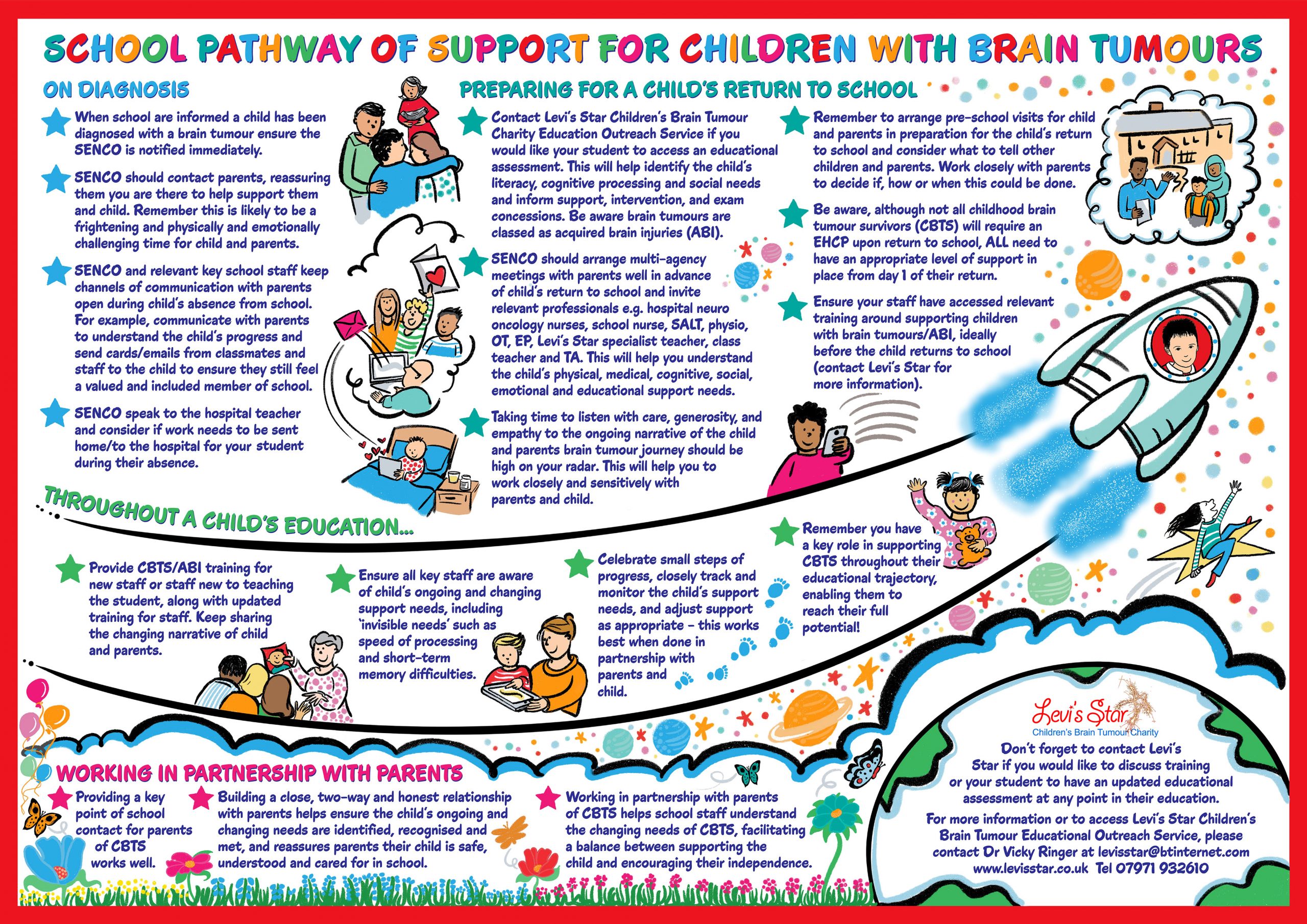
Key findings of our research also highlighted a need for key school staff to have access to a visual pathway of support guiding support for children living with the effects of a brain tumour which we have summarised as:
Visual school support pathway for children/young people with brain tumours:
When?
We offer education support and advice to children and young adults who are receiving, or have completed, treatment for a brain tumour. There is no time limit on the support offered, as we are committed to providing the right support to children, young people and families at a time when they need it.
Where and How?
We work with children, young people, and schools/colleges across Yorkshire. We work closely the LGI who often refer children, families and schools to our service. Vicky Ringer is our specialist teacher and leader of the education outreach service, please feel free to contact her if you have any concerns regarding school support for your child. We also welcome referrals from other hospitals, social workers, GPs, schools and self-referrals. In short, anyone who has the permission of the parent or carer can refer to us. Please contact Vicky Ringer, Children and Young People’s Brain Tumour Education Outreach Specialist, for more information about this service on:
Vicky Ringer – Specialist SEN Teacher and Service Leader, supporting 0-25 yrs
07971 932610 or email levisstar@btinternet.com